Showing posts with label Breed Profile. Show all posts

Tuesday, December 5, 2023

Breed Profile: Pumi

 The Pumi is a small/medium sized herding dog from Hungary.


In the 17th-18th centuries, the Pumi was likely developed by crossing Pulis, Pomeranians (and other spitz), Briards and assorted terriers.


The Pumi was originally used as a drover of cattle.  His work ethic gained him other jobs around the farm- herder, hunter, vermin killer and guard.  The Pumi herds/droves by close contact, rapid movement, barking and nipping.

Ever the active dog, the Pumi is also known to participate in obedience, dancing and agility...


Lifespan:  12-14 years

Height:  15-19 inches at the shoulder

Weight:  18-33 pounds


The coat is curly and grows constantly, similar to a Poodle coat. It must be trimmed every 2-4 months.  Coat colors: black, white, cream, red, grey


The Pumi personality is affectionate, independent, lively, bold, expressive, suspicious of strangers, intelligent, highly inclined to bark and possesses a playfulness that is maintained into adulthood. 

Tuesday, February 25, 2020

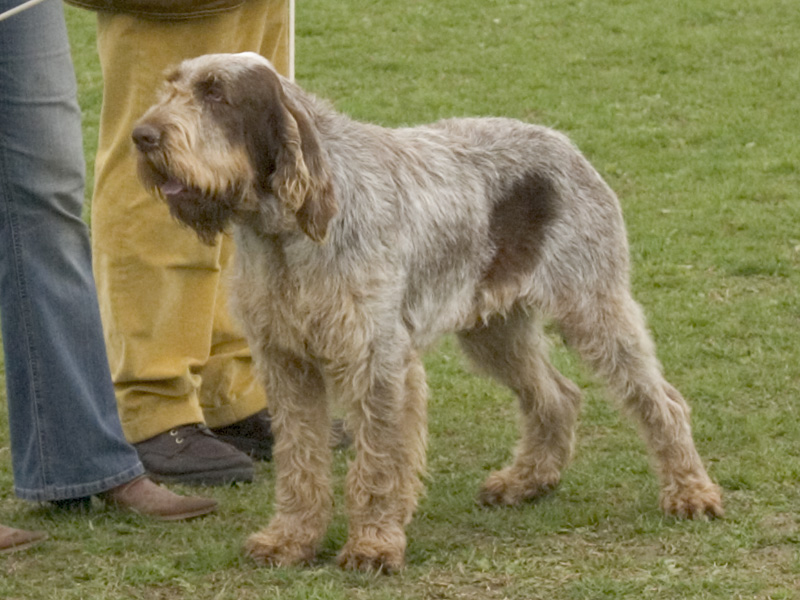
Breed Profile: Spinone Italiano


The Spinone Italiano is easy going, affectionate and a versatile hunter.  Spinone Italiano means Italian Griffon.


Photo by  Caroline Granycome


Believed to have originated in the Italy's Piedmonte district where the terrain is rough, the sturdy Spinone was used to point, set and retrieve water fowl, upland fowl and small furry animals.  Fifteenth century Italian artwork features dogs that look very much like Spinoni.


Photo by I, Johami


Spinone Manifesto


-  I am not a hyper pointer, don't hog the couch.

-  my beard disguises loose jowls.  There will be slobber.

-  if you want a watch dog, get an Akita.


Photo by Alephalpha


Some Spinone Italiano Facts

-  weight:  male 75-86 #, female 64-75#

-   height:  male 24-28", female 23-26"

-  lifespan:  12-14 years

-  single wiry coat.  Colors:  white, brown roan, orange and white, orange roan


Photo by Brad Patrick


Some say the Spinone is such a natural hunter that he doesn't need training.  That is probably hyperbole.  Still, he is an able hunter who does not limit himself to just pointing, setting or retrieving.  He does it all.

He is also a family dog and would be unhappy living outside in a kennel.  The Spinone gets along with other dogs and is patient with children.  His webbed feet make him a good swimmer.


Photo by Alephalpha


Spinone are loyal and docile.  However, they are intelligent enough to learn quickly and are therefore not keen on repetition or drilling.

They are friendly and amiable to strangers.  Though Spinone are an active breed, their exercise needs can be met by a daily walk and a romp session.


Friday, October 20, 2017

Breed Profile: Great Pyrenees

The Great Pyrenees (AKA Pyrenean Mountain Dog) was originally used as a flock guardian.  The breed has been around at least since 3000 B.C. when nomadic shepherds brought their sheep and dogs to the Pyrenees Mountains.  Today, many GP's still work as guardians.  Many are pets,  companions, therapy dogs.


Some Great Pyrenees Facts
 - lifespan 10-12 years
-  height:  25-32 inches at shoulder
-  weight:  85-115 pounds
-  double dewclaws on hind legs
-  double coat in white or white with some markings.  The undercoat is dense and wooly, the outer coat is coarse and straight
-  recognized by the American Kennel Club in 1933, a member of the Working Group


The Great Pyrenees is often described as majestic.  (Strangely, the Fright Wig is rarely mentioned.)
GP's are also described as calm, confident, alert, affectionate, strong willed, gentle with family and animals of the home, suspicious of strangers, fearless and serious.


 Great Pyrenees Manifesto

- yes, I do bark a lot.  It's because I take my guardian job seriously.


-  if you are looking for a dog who loves everything and everybody that wanders by, get a Golden Retriever


-  you needn't trouble yourself telling me what to do.  I have everything under control.  You're welcome. 


I don't always sit down on the job.  But when I do, it's in a comfortable chair.

Tuesday, February 9, 2016

Breed Profile: Pomeranian

Like most members of the Toy Group, the Pomeranian is small and considered a companion.  He is however, outgoing, vivacious, reasonably intelligent, curious and bold, thus qualified for other pursuits such as therapy, obediance competitions and whatnot.


Pomeranians get along well with other dogs and cats but some give in to the impulse to chase small critters.  This tendency allows for some Poms to make good ratters. 


Not a mouse, just a chunk from a rotted tree stump.
  Still, this Pomeranian chased it, caught it and captured it.


Some Pomeranian Facts

-  lifespan:  12-15 years
-  weight:  3-7 pounds
-  height:  8-11 inches at shoulder
-  double coat: undercoat is soft and dense, outer coat is straight with a harsh texture
-  coat colors:  just about any color and any pattern, such as blue, black, red, brindle, cream, orange, shaded (variations on a color or colors), sable (three or more colors)...


Our in-house model features a black and white coat pattern. 

Bred down to smallness from sled dogs sometime in the 1800's, presumably in the region in Germany/Poland called Pomerania, the Pomeranian has the same body type as a Spitz:  prick ears, high set tail that lies flat on the back, thick coat, medium boned, sturdy, compact.

The personality of the Pom is confidence bordering on cocky, fearless on the verge of reckless, commanding to the brink of bossy.


Pomeranian Manifesto

-  if you are not charmed by the ultimate swaggering small dog, you are not fit to live with a Pomeranian

-  you may think I am barking for no reason.  You would be wrong.  I am simply alert.  You're welcome.

-  don't let the rugged coat of my Nordic ancestors let you forget that I require the luxury of indoor living


Sunday, March 1, 2015

Breed Profile: Labrador Retriever

The Labrador Retriever is not originally from Labrador, but from Newfoundland.  His original job was to help fishermen pull their small boats into the harbor, drag fish nets out of the water, and to retrieve waterfowl.

 Not used so much by fisherman anymore, today's Labrador Retriever is employed as a hunter's helper,  a guide for the blind, assistant to the disabled, show dog, law enforcement, fly baller, search and rescue, agility, and game for most any activity involving his people.


The Lab is a cheerful, energetic, enthusiastic, amiable dog.  He is slow to mature, so owners must be ready to endure puppy style attitude well into the dog's second year.  Exuberance aside, given proper instruction, Labs tend to be patient and trustworthy around children and other pets.  Their keen desire to retrieve things can be channeled.  If it is not, prepare for the inevitable.  The dog will "retrieve" your slippers from the floor beside your bed before you step into them.  The dog will "retrieve" unidentifiable objects from the yard and bring them into the house.

This high energy dog needs exercise and activity to keep him from creating things to do such as chewing the sofa.  Speaking of chewing, Labs tend to be very mouthy.  Provide appropriate toys for them to chew and teach them what is and is not ok to put their in their mouth.  


The double coat of the Labrador Retriever comes in black, yellow and chocolate.  The outer coat is short, straight and dense, the under coat is soft and water resistant.  Yes.  Labs shed.  In abundance.


Lab Manifesto

- you've heard I'm easy to train.  That is true as long as you keep the treats coming and are willing to repeat yourself (and the treats)

- if you are looking for a mellow dog, get a Mastiff

- my otter shaped tail is a weapon that I don't mean to use but cannot help but use.  Please don't yell at me when my inherent joy causes my tail to sweep glasses off the coffee table, slap adults on the thigh or little kids in the face

- I like everybody so if you want a watch dog, get a suspicious character in here, like a terrier or a goose.


Some Lab Facts

Life span :  12-14 years
Height:  21.5 - 24 inches
Weight:  55-80 pounds 

Friday, July 4, 2014

Breed Profile: Boxer

The Boxer is an athletic amiable dog, prone to antics. 

Due to his strength, eagerness to do things with his people and a short nose allowing for a good grip, the Boxer was originally used to hunt and hold large prey such as bears, wild boar and deer.  In Germany during the 19th century, the Boxer worked with police, performed in circuses and as Butcher's Dogs, their job to keep cattle in slaughter yards under control.

During the World Wars, Boxers served as pack-carriers, sentries and messengers.


Some Boxer Facts

- life span:  10-12 years

- height at shoulder:  21-25 inches

- weight:  50-80 pounds

- the coat is short and smooth.  Colors:  fawn, brindle, with or without white and black markings


Boxers are cheerful sturdy dogs that enjoy being with children.  They usually do OK with other dogs but can sometimes be aggressive with dogs of the same sex.  Cats and Boxers can live in harmony as long as they have been raised together.  Boxers tend to chase small animals such as rabbits and rats (even if you consider these creatures part of the family).


Boxer Manifesto

don't call me high strung.  I am exuberant.

-  I am not an outdoor dog, unless we're doing something fun together outside.  After-words, I expect to return with you to the comfort of your bed

-  those who call me stubborn are obviously not intelligent enough to merit my obedience


Sunday, March 16, 2014

Breed Profile: German Shepherd Dog

The German Shepard Dog was originally used as a herder.  This dog's work ethic was so impressive, soon the GSD was offered other jobs.

Ever indomitable, the intelligent, strong, energetic GSD continues to tackle all and sundry responsibilities asked of him.

The list of GSD accomplishments/abilities is long.  Here are a few: police dog, therapy dog, search and rescue, narcotics detection, explosive detection, guide dog, war dog, dock diving, lure coursing, show dog, companion, professor of anthropology (just kidding).


GSD are serious dogs, highly motivated for meaningful activity.  They are extremely loyal and protective of their families, suspicious of strangers, smart, confident, a bit bossy, not inclined to tolerate clowns.


Some German Shepherd Dog Facts

-  also known as:  Alsatian, German Shepherd, Shepherd Dog

-  life span:  10-12 years

-  average age of maturity:  1.5 years

-  height at shoulder:  22-26 inches

-  weight:  60-95 pounds

-  double coat, colors:  black and tan, black, white, black and silver, black and cream, black and red


German Shepherd Manifesto
 
-  yes, I shed.  Everyday. Deal with it.
 
-  another dog is unnecessary.  You have me.
 
-  give me something to do.  Otherwise I will find something to do.  I'll start with reorganizing the kitchen cupboards, redecorating the bathroom, herding the neighborhood children, disconnecting the cable...

Tuesday, November 12, 2013

Breed Profile: Mastiff

Pictures and descriptions of mastiff-like dogs go back as far as 4,000 years ago.  Mastiffs have been used to guard flocks and families.  Mastiffs have served as hunters for such game as lions and wild horses.  Mastiffs have been called upon to fight, in wars, as gladiators and for bull and bear baiting.

The Mastiff of today is a guardian.  Not, however, the type of guard dog that patrols the grounds, but  the type of guardian that lives with and protects his family.


Indeed, the Mastiff would rather not be left outside all the time.  He prefers to be with his people.  Though not a high energy dog, he is strong steady presence, calm and easy going.  The Mastiff is gentle, even with children pulling on his ears.

Because the Mastiff is very large and heavy, if he accidentally steps on your toe or wags his tail over a fully set coffee table, breakage may occur.


Some Mastiff Facts
 
also known as:  Old English Mastiff
 
-  weight:  120-230 pounds
 
-  height:  27-30 inches (at shoulder)
 
-  life span:  9-11 years
 
-  short double coat
 
-  coat colors:  fawn, apricot, brindle, with dark muzzle, ears and nose


Mastiff Manifesto
 
 
-  once I know the rules of the house, I will follow them, in my own good time
 
-  if you want a giddy emoter, get a Bishon Frise.  Meanwhile, hold still while I lean on you.
 
-  that's right.  I drool.  Keep towels handy or I'll be forced to use your lap as a napkin.


Saturday, October 5, 2013

Breed Profile: Border Collie

Sometime during the 1800's, in the area between Scotland and England, they say a sheepdog named Hemp sired the first litter of what would become the Border Collie breed.

Unlike other sheepdogs who move a herd with barking or nipping, the Border Collie "gives eye".  Through the power of staring, the dog intimidates the sheep into moving.


In addition to the eye, the Border Collie has another distinctive feature:  the crouch.  The dog moves low to the ground in somewhat cartoon sneaking up fashion.  The crouch and the stare and the work ethic of the Border Collie make him very good at his job.

The Border Collie of today maintains that serious work ethic.  Thus, he is still used to herd animals.  For those who don't have any sheep or ducks to herd, the Border Collie's talents translate elsewhere, such as flyball, Frisbee, agility and obedience competitions.

Failure to give a Border Collie plenty to keep his athleticism and intelligence challenged may result in him taking matters into his own hands, so to speak.  He might decide to rearrange the furniture in the living room including moving around the stuffing from the couch cushions.  He might figure out how to open a kitchen cupboard and help himself to a box of mac and cheese.  Worse case, he may take up a neurotic repetitive past time such as pulling all the hair off his tail or pacing till he wears a groove into the floor.


Some Border Collie Facts

-  weight:  42-52 pounds

-  height:  18-22 inches

-  life span:  12-15 years

- coat:  double, yearly shedding.  Brushing a couple times a week keeps the coat in good shape

- coat colors:  pretty much all colors, solid, bi color, tricolor, merle


Border Collie Manifesto

if you want a blithe extrovert, get a Golden Retriever

-  if you need some critters moved or a ball caught, I'm always ready.  Now.


Wednesday, August 28, 2013

Breed Profile: Great Dane

The history of the Great Dane is slightly murky.  We are reasonably sure it was fully developed in Germany some 400 years ago.  However, there is some discrepancy in what went on prior to that.  Some say a Great Dane-like dog was seen and described in China around 1100 BC.  Some say there are pictures of dogs resembling Great Danes in Egyptian tombs.

The Dane is thought to be a product of crossing the now extinct Molossus war dog (believed to be the progenitor to the English Mastiff) and a Greyhound or an Irish Wolfhound or both. 

One look at the Dane of today, Mastiff qualities are obvious -especially the head and Sight Hound qualities are obvious -especially the deep chest and tucked waist.


Why is a dog from Germany called a Dane, you ask?  It was called German Boarhound for a while, but later, somehow Great Dane stuck.  One theory is that the name came from the French "grand Danois" which means big Danish.  Of course, that still fails to explain why a dog from Germany is called a Dane.
 
Great Danes were originally used to hunt wild boar.  Later they were used to guard estates.  After that, they took the job they hold today:  companion.


Some Great Dane Facts
 
-  height:  28-36 inches
 
-  weight:  110-180 pounds
 
-  life span:  7-11 years


The short haired Great Dane comes in a variety of colors/patterns: fawn, brindle, black, blue, harlequin, mantle.  The coat is easy to care for, requiring occasional brushing and bathing as needed.  The ears are naturally droop.  Some Great Dane owners crop the ears into an upright point. 
 
 
Great Danes are affectionate, friendly, calm dogs that prefer to be inside the house with their people.  They are intelligent enough to be trained, but not so bright that you have to forever entertain and challenge their minds.


Great Dane Manifesto
 
-  yeah, I'm a Gentle Giant.  That's why I'm asking you politely to move over so I can take over the couch
 
-  the cat and the other dogs can squeeze in next to us


Tuesday, July 9, 2013

Breed Profile: Schipperke

The Schipperke is a small sturdy spunky dog believed to have been developed in the 1600's in Flemish regions of Belgium.  Bred down in size from the Leauvenaar, a sheepdog, the Schipperke was used by tradesmen and river bargers as a ratter and watchdog.  Schip is the Flemish word for boat.


Some Schipperke Facts 
 
- weight:  10-16 pounds
 
-  height at shoulder:  10-13 inches
 
-  life span:  13-15 years
 
-  Also Known As:  Little Captain, Little Boatman, Belgian Barge Dog
 
-  harsh fairly short double coat, black, spitz style
 
-  many are born without tails, those born with a tail usually have it docked


Today's Schipperke likes to keep busy in his job as companion and is involved in all activities going on in the household.  An alert dog with a sharp bark and suspicious nature, the Schipperke is a very good watchdog.  


Schipperke Manifesto
 
-  I'm not willful.  I simply have everything under control
 
-  I am smarter than you but will not hold that against you
 
-  we'll get along fine, if you have a sense of humor


Tuesday, May 21, 2013

Breed Profile: Golden Retriever

Given their sturdy beauty and affable nature, it is not surprising that the Golden Retriever is a popular family dog.


Some Golden Retriever Facts

-  height at shoulder:  22-24 inches

-  weight:  55-75 pounds

-  life span:  10-12 years

-  coat colors:  cream to reddish gold


Yes, they shed.  (They are, after all, mammals with hair.)  Golden Retrievers have a double coat.  The under coat is soft and provides insulation from both heat and cold.  The outer coat is not "water proof" but does have a water deflection quality - imagine the hairs like grass covered in dew.  This coat works well when the dog is retrieving game in water or cavorting with children in a kiddie pool.

Caring for the coat requires at least twice weekly brushing to avoid matts.


In mid 19th century England, desiring a retriever tough enough to handle rugged terrain and a strong swimmer with a good work ethic, some careful breeding was undertaken by Sir Dudley Marjoribanks, the Lord Tweedmouth.  Speaking of mouths, the retriever also required a "soft mouth".   In other words, the dog shouldn't damage the bird by carrying it.  An intact bird makes for better eating, don't  you know.

Sir Dudley began with a dog named Nous (a yellow Wavy-Coated Retriever- a breed used by fisherman developed from Newfoundlands and Labrador Retrievers) and Belle (a Tweed Water Spaniel- a liver colored retriever with a curly coat).  This union produced four puppies. 

These dogs were then combined with assorted retrievers, more Tweed Spaniels, setters and Bloodhounds to develop what was then called the Flat Coated Retriever. 

In the early 1900's the breed came to the USA.  In 1927 the American Kennel Club officially recognized the Golden Retriever.


Golden Manifesto
 
-  everybody is my friend, I just haven't met them all yet
 
-  I will vivaciously participate in obedience, service work, search and rescue, hunting, agility, rally, therapy, nanny duty, whatever- all I ask is not to be left alone, I am a social creature
 
-  if you want a watchdog, get a Terrier (oh good!  I'll meet another friend!)


Golden Retrievers are strong, athletic and full of energy.  For best results, offer them plenty of exercise, play and something to do!


Friday, April 5, 2013

Breed Profile: Irish Wolfhound

The Irish Wolfhound is the tallest of the Sighthounds.  When standing on his hind legs, he is about six feet tall.


Some say that around 1500 BC, large dogs resembling today's Irish Wolfhound were brought from Greece to Ireland.  In 391 AD, in Rome, tales were told of such large dogs fighting wild animals in the arena.  In the eighteenth century, the Irish Wolfhound were used to hunt elk and wolves.  The dogs did such a good job, that elk and wolves were pretty much wiped out in Ireland, nearly putting the Wolfhound out of business.   


Some Irish Wolfhound Facts
 
-  height at shoulder:  30-35 inches
 
-  weight:  105-180 pounds
 
-  life span:  5-7 years
 
-  coat:  wiry, rough
 
-  coat colors:  gray, red, black, white, fawn, brindle
 
-  no longer used as a hunter, their current job is family member


Slow to mature, the Irish Wolfhound is not full grown physically nor emotionally until well after one year of age.  Once they are grown-up however, the Wolfhound is a calm, enchanting companion.  They are easy going, patient with children, other pets and other dogs.  Still, being a sighthound, these dogs retain the innate desire to chase assorted critters like deer and squirrels.
 
Irish Wolfhounds are big furry greyhounds that require exercise.  A long daily walk is usually adequate.  The Irish Wolfhound is intelligent and learns quickly.  Thus, he is prone to boredom with repetitive or drill style training.  
 
Those who live with Irish Wolfhounds usually describe them as sweet, gentle and affectionate but not effusively nor indiscriminately.


Irish Wolfhound Manifesto
 
-  I am not a couch potato, but I will take over the couch
 
-  if you want a watchdog, get a Terrier
 
-  I am not indifferent.  I am mellow  


See some nice pictures.
 
 
Next Breed Profile:   Golden Retriever!

Tuesday, March 5, 2013

Breed Profile: Collie

 
Farmers in Scotland used dogs to herd sheep.  They were called Colley Dogs.  Both the rough coated Collie and the smooth coated Collie are thought to have come from these Colley Dogs.  Most farmers used the smooth coated Collie as drovers and the rough coated Collie to stay with the flock, their coat allowed them comfort on the job in all sorts of weather.
 
Around 1860 Queen Victoria took a liking to Collies and the breed became popular among the upper classes.
 
Meanwhile in America, there was sheep herding going on.  Collies were brought to the states and put to work.  Soon their delightful personalities as pets and companions and baby sitters gained attention.


Some Collie Facts
 
- life span:  8-12 years
 
-  height at shoulder:  22-26 inches
 
-  weight:  50-75 pounds
 
-  two coat versions: Rough - soft undercoat, straight, harsh, long outer coat, and Smooth - soft undercoat, short and flat outer coat
 
-  coat colors:  tri color (white, black, tan),  fawn, cream, gold, sable with white, and blue merle (originally called tortoise shell)


 Collies are not only accomplished at herding, they have also racked up success in the show ring, obedience, acting in movies, delivering messages in wartime and as trustworthy family members. 
 
Like most breeds originally bred to do a job, it is important to offer a Collie regular exercise to keep him from getting antsy. 
 
The Collie is friendly with most everybody but is also discerning.  In other words, you may be fooled by a con man, but your Collie won't be. 
 
Collies are gentle and patient, making them terrific with children and baby ducks.


Collie Manifesto
 
-  yes, Lassie was a goody goody.  You got a problem with that?
 
-  I love kids and other dogs and birds and cats and people and sheep and cows and horses and assorted other critters I haven't met yet.  I love to round them up.


Next Breed Profile:   Irish Wolfhound!  

Friday, February 1, 2013

Breed Profile: Yorkshire Terrier

During the 1800's weavers from Scotland brought their little dogs with them to work in English mills.  Those dogs were bred with assorted terriers, many now extinct, to develop what became known as the Yorkshire Terrier.  At first, the Yorkie worked as a ratter and pet for working class folks.  Soon the upper class noticed the pretty dogs.  The Yorkie was bred down in size- the better to be a lapdog.  The Yorkshire Terrier may have gotten smaller but he did not lose his vermin hunting prowess, nor his spunky attitude.


Yorkie puppy


Yorkie adult


Some Yorkie Facts

- height at shoulder:  8-9 inches

- weight:  under 7 pounds

-  life span:  14-16 years

- the long silky coat requires regular brushing to keep it looking good and free from mats


The Yorkshire Terrier is intelligent, nosey, self confident and determined.  That's why training a  willful, easily bored, frequently distracted, stubborn Yorkie is challenging.

Though delicate looking and seeming to belong tucked onto a lap, the Yorkie is a terrier.  Terriers can certainly be affectionate and enjoy a nice cuddle,  they also like to keep busy exploring, hunting varmints and supervising the other members of the household.  Thus, as a Yorkie might say, if you want a lap dog, get a King Charles Spaniel.


Yorkie Manifesto

-  who you calling small?!  I am most certainly not small.

-  if you want a dog that cheerfully endures ear pulling by toddlers, get a Golden Retriever

-  I am beautiful even with mouse entrails in my beard


Yorkshire Terriers are high energy dogs that need exercise.  Due to their small size, a short walk and some play around the house, along with their bustling nature, keeps them fit.  Other pets and Yorkies can live peacefully together.  However, supervision may be needed with larger dogs as the Yorkie can be pushy and more aggressive than his brawn can back up.  Pets such as hamsters, must be protected, as that terrier spirit is likely to see them as prey. 

Young children may inadvertently injure the petite Yorkshire Terrier, therefore, this is a breed best suited to adults and older gentler children.

Always alert to goings on, the Yorkie is a good watchdog.  He is not shy about barking.


Next Breed Profile:  Collie!

Wednesday, December 19, 2012

Breed Profile: Siberian Husky


Long ago, the nomadic Chukchi people of Siberia developed dogs for transportation.  The dogs needed strength to pull a sled and the endurance to do so for long distances.  These gentle dogs lived closely with the people, often sleeping with the children at night.

Miners during the Alaska Gold Rush used the Husky for travel.  It was also during this period that  dog sled racing became popular.  Siberian Huskies, smaller and more cooperative than other Huskies gained attention because they tended to win races.

The Siberian Husky of today still loves to run.


Some Siberian Husky Facts

also known as Arctic Husky

-  life span 12-14 years

-  21-23 inches at the shoulder

-  40-60 pounds


In 1925 a team of Siberian Huskies ran some 340 miles to deliver diphtheria serum, saving the people of Nome.  During World War II, Huskies served on search and rescue teams for the army. 
 
 
The double coat of the Siberian Husky provides insulation to keep him warm in cold weather.  The coat also insulates against heat, allowing the Husky to tolerate most all weather conditions. 
 
Weekly brushing and an occasional bath keep the coat in good shape.  Twice a year the coat "blows" which means the entire undercoat is shed.  The Siberian Husky's coat comes in all colors from pure white to pure black, various markings on the face and body are common.  A Husky sometimes has brown eyes, sometimes blue eyes, and sometimes one of each.


Siberian Husky Manifesto
 
-  I sneak out of the yard not because I don't like living with you but because I so enjoy exploring
 
- if you are want a guard dog, get a Kuvasz
 
- sure I'm stubborn but I am also incredibly cheerful and delightfully puckish


A Siberian Husky needs exercise and lots of it.  If he doesn't expend his formidable energy by running, playing, pulling a sled, skijoring, jogging, hiking, agility or some other desirable way, he may take up less desirable pastimes such as digging, chewing or howling.


See some more pictures .


Next Breed Profile:  Yorkshire Terrier!